
Box Modern Passive Solar House
Hillside home combines passive design and Oblique™ Weatherboard for high performance.
This hillside Napier residence demonstrates how passive house principles and strategic material selection can deliver a high performance home with striking good looks.
With their three daughters grown and living away from home, Jee and Peng had been considering downsizing when they discovered an exceptional north-facing site with commanding views across Napier’s landscape. “Out of curiosity, we went to visit the piece of land the following weekend, and were besotted by the magnificent views. We immediately decided to pay a deposit on a north-facing site,” says Jee.
The couple assembled a team specialising in sustainable, high-performance design. They were keen to work with eHaus, specialists in passive house design and construction, and use innovative techniques and sustainable materials to create a high-performance energy-efficient home.
The eHaus approach prioritises airtight construction, superior insulation, controlled ventilation and solar orientation to minimise energy consumption while maximising comfort – a methodology gaining significant traction among New Zealand designers seeking to future-proof homes against rising energy costs and climate concerns.
Architectural designer Dean Baldock, an eHaus partner, designed Jee and Peng’s 250m² two-level, three-bedroom house. With distinctive floor-to-ceiling picture windows positioned to capture views and optimise passive solar gain, the home’s reflects the Box Modern aesthetic, which is characterised by clean geometric forms, flat or low-pitch roofs, and strong horizontal and vertical lines.
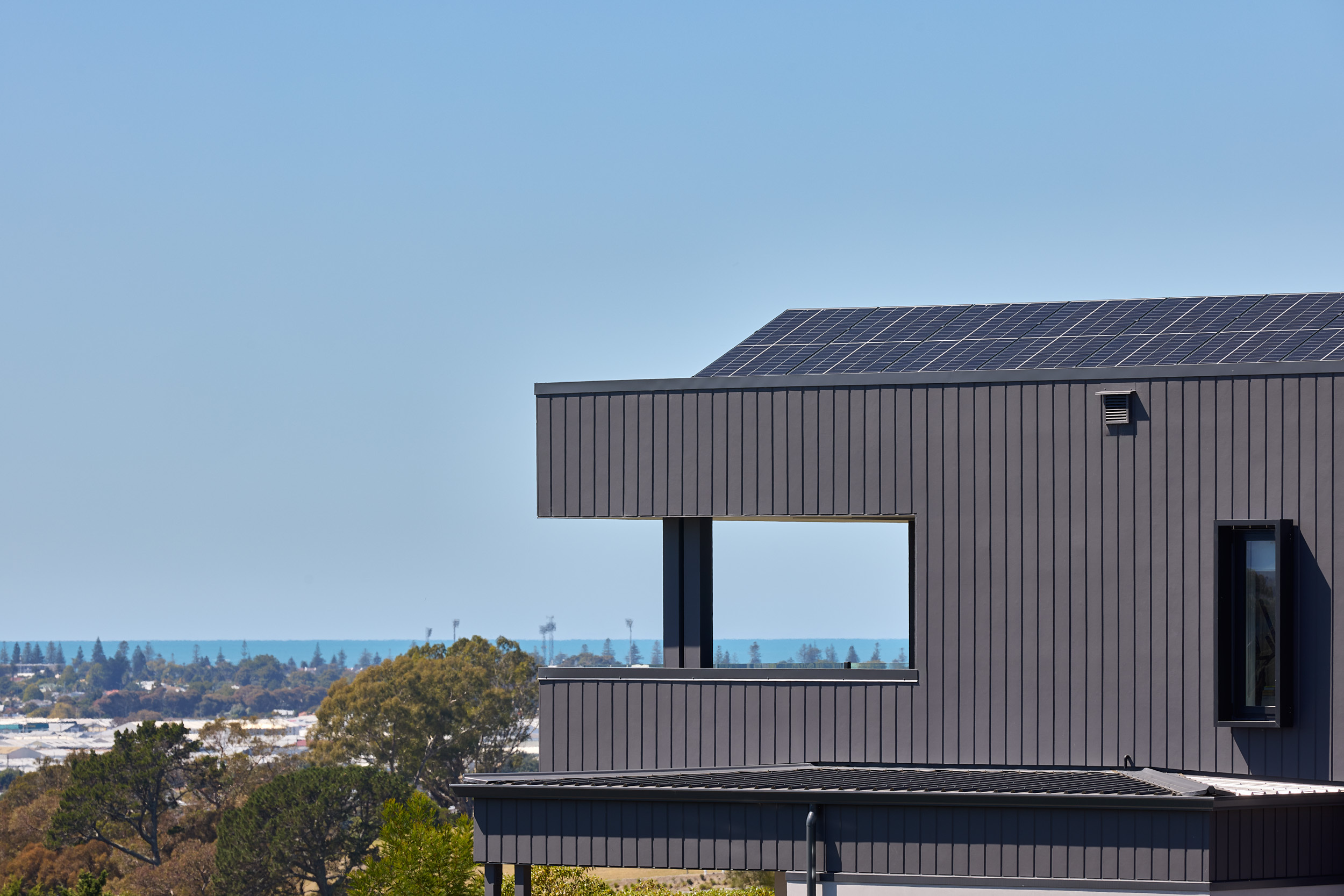
For the exterior cladding, Dean specified Oblique™ Weatherboard by James Hardie across much of the upper level. The fibre cement product’s ability to be installed both horizontally and vertically offered crucial design flexibility, allowing him to emphasise the building’s geometric forms and create visual interest through directional changes.
“When combined with the right paint system, Oblique™ Weatherboard can be used with a darker finish. The homeowners chose Dulux Colorsteel ® FlaxPod ® to create a modern aesthetic and help the upper level stand out.
With the ability to install vertically, it also supports modern aesthetics and versatility, whilst remaining durable against our dynamic climate.” This finish colour flexibility addresses an increasing challenge for designers pursuing contemporary aesthetics.
Dark cladding colours have become a defining trend in New Zealand architecture, helping homes recede into landscapes or create dramatic contrast. However, darker tones absorb significantly more heat, causing traditional timber weatherboards to warp, cup and deteriorate prematurely. Hardie™ Fibre cement’s dimensional stability means designers can specify dark palettes without compromising envelope performance, which is particularly important in passive house construction where maintaining airtightness and thermal efficiency is critical. The interior layout reflects both current lifestyle needs and future adaptability.
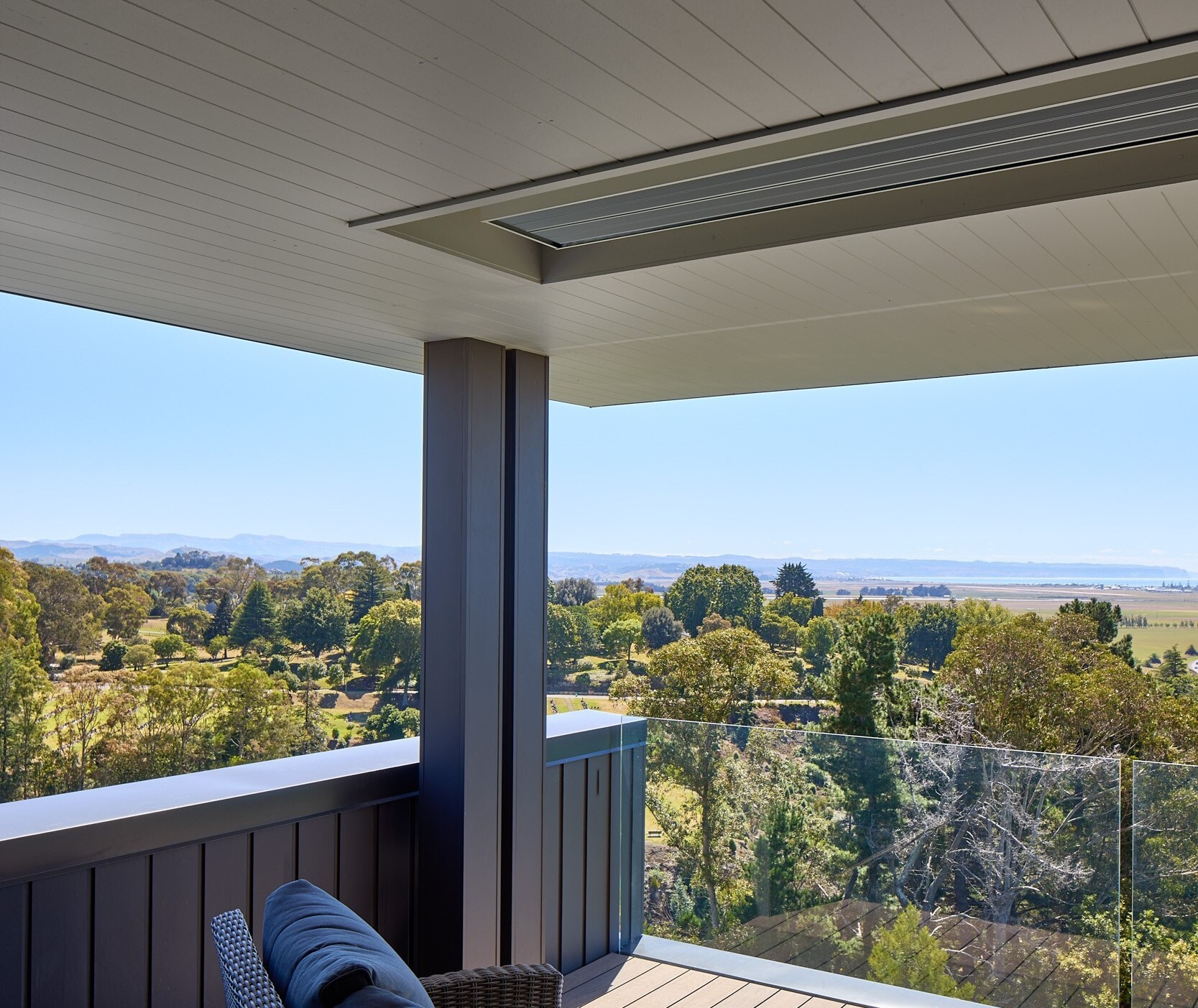
The upper level includes the main bedroom and a second living area with a kitchenette to provide independence and privacy when guests are staying. Downstairs, an open-plan living and dining space opens to a covered patio with heating for year-round use. The ventilated “closed kitchen” is another distinctive design feature. “It’s like an enlarged scullery.
We call it the chef’s kitchen and it has a sliding door to close it off. It is made for Chinese cooking which usually has strong aromas. We can stop them from wafting through the house as much as possible,” says Jee. Nothing has been left to chance. The home is pre-wired for an internal lift, should it be needed in the future. It also has solar panels on the roof and a 5000-litre water tank to provide self-sufficiency in an emergency. Hardie™ Groove Lining features on the soffits, its vertical lines echoing the double post design of the sheltered outdoor living areas and tying in visually with the overall aesthetic.
The Hardie™ fibre cement material ensures these exposed horizontal surfaces maintain their integrity in Hawke’s Bay’s variable climate without the maintenance demands of timber alternatives. For architects and designers pursuing passive house certification or simply seeking to deliver high-performance homes, material selection directly impacts long-term building performance.
The durability and low maintenance requirements of James Hardie fibre cement cladding align with passive house principles by ensuring the building envelope maintains its integrity over decades, not just years. Jee and Peng couldn’t be happier with their new home. “We love the views, the warmth and the functionality.” When asked if they would do anything differently if they were to build again, their answer was simply: “No.”
Oblique™ Weatherboard & Hardie™ Groove Lining, Hill-top Haven in Hawke's Bay
Oblique™ Weatherboard & Hardie™ Groove Lining, Hill-top Haven in Hawke's Bay
Location
Napier, Hawke’s Bay
Featured Products
Project Type
Residential | Modern | New Build
Industry Professionals
Designed by Dean Baldock, The Architecture People, for eHaus and built by Welch Builders & Construction
Similar Projects
Passive House Design Using Axon™ Panel
Residential | Modern | New BuildPassive House Design Using Axon™ Panel
Residential | Modern | New BuildA low-maintenance, energy-efficient dream home using Axon™ Panel was designed to achieve NZ Passive House Certification.
The Design Book
BUILD YOUR MODERN LIFE
The Hardie™ Cladding Collection has a wide variety of products to select from, creating design versatility, in which It’s Possible™ to Make Modern™ like never before. It’s a movement that’s reshaping perceptions and changing the way New Zealand builds. Whether you are planning a renovation, new build, or extension, this forecast will be an invaluable tool on your journey. Welcome to the James Hardie Design Handbook. It's time to Build Your Modern Life.
NEED SUPPORT?
For immediate general and technical assistance you can call 0800 808 868
Talk to one of our CustomerLink or Technical Team Consultants
Where
To buy our products
Get
The James Hardie Product Guide
See
James Hardie's Modern Design Forecast